Retirement Planning: Inflation and Social Security COLA Update
When it comes to retirement planning, inflation and Social Security are two of the most important considerations. Inflation reduces the purchasing power of savings over time, which is why it’s important to manage a portfolio that can offset this effect. Naturally, Social Security also supports retirement objectives by providing income that increases with inflation, based on an annual Cost-of-Living Adjustment (COLA).
Both of these concepts have experienced recent changes, so I want to share some perspectives on the new 2027 COLA, what’s driving inflation across the economy, and what it means for generating income from your portfolio.
The 2027 COLA reflects higher energy prices
Inflation remains one of the biggest challenges in retirement, and has faced two competing trends over the past year. Overall inflation from the pandemic has been improving, with the Consumer Price Index decelerating from a peak of 9.1% year-over-year in 2022 to 2.7% at the start of 2026. However, rising energy prices due to the war in Iran have pushed inflation higher in recent months.
In response, the Social Security Administration recently announced a 3.6% COLA for 2027, one of the highest in recent decades.1 This is a healthy increase on paper, but the reality is that this is only one part of an overall strategy for staying ahead of inflation.
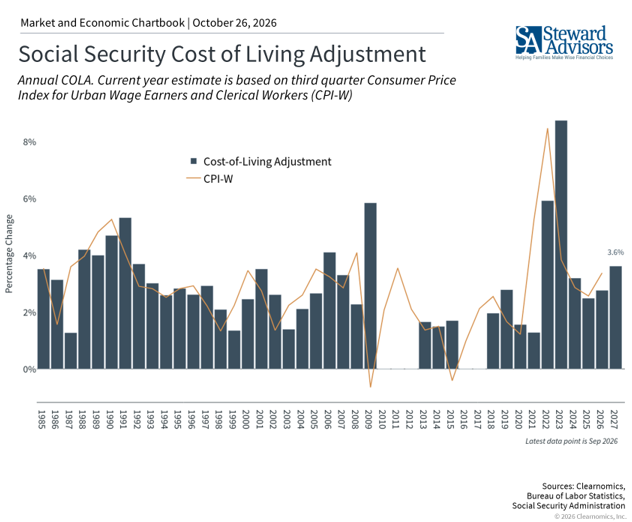
This COLA adjustment for 2027 is the fifth-largest increase in over 35 years. COLA is calculated using a version of the Consumer Price Index which is commonly used to measure inflation.2 The challenge is that it’s difficult for one number to reflect the needs of all retirees.
For example, the latest COLA figure means that the average Social Security recipient will see approximately $75 more per month beginning in January 2027. While this is positive, retirees have a larger proportion of their expenses in categories such as healthcare, prescription drugs, and other necessities, so they are often more sensitive to inflation in these categories.
More broadly, inflation continues to be a challenge across many parts of the economy. Headline CPI rose 3.7% year-over-year in September, with gasoline prices accounting for more than half of the monthly increase with a surge of 9.1%. In contrast, core CPI, which excludes food and energy prices, rose only 2.6%.3
These figures suggest that the primary driver of today's inflation is still oil prices, rather than broad-based price pressures spreading across the entire economy. It’s natural for higher inflation to hurt consumer sentiment, which has fallen to historic lows.
Despite higher inflation and uncertainty in the labor market, consumer spending has been strong. Business investment has also remained steady, supported in part by ongoing AI-related capital spending on data centers and infrastructure. Together, these factors have helped to support broad economic growth, corporate profits, and financial markets, despite many ongoing challenges.
Takeaways for your portfolio
While economic growth continues to be stable, the combination of inflation and higher interest rates creates additional challenges for long-term investors. Interest rates are elevated, especially compared to much of the past decade when they were hovering close to or at zero. Still, the inflation-adjusted yields on cash remain lower than many investors might expect and are lagging behind inflation, on average.
This is why, for many investors, annual COLA adjustments are helpful, but are only one part of the overall picture. A balanced portfolio including allocations to stocks and bonds, when structured properly, can potentially offer more attractive real returns than cash alone, which can help support your broader retirement plan.
As always, please feel free to reach out if you have questions or would simply like to talk through how any of this relates to your specific situation and retirement goals.
References
1. https://www.ssa.gov/news/en/press/releases/2026-10-14.html
2. https://www.ssa.gov/oact/cola/latestCOLA.html
3. https://www.bls.gov/news.release/cpi.htm